Learning how to write a freelance proposal that wins is one of the highest-leverage skills in a solo service business. You can have strong portfolio work and still lose deals to freelancers who communicate scope, confidence, and next steps more clearly.
This guide gives you a repeatable structure, copy-ready section templates, pricing patterns that reduce friction, and a workflow to draft faster— including AI-assisted proposal drafting that saves time without producing generic slop.
What clients look for in a freelance proposal
Clients rarely hire the best designer or developer in absolute terms. They hire the person who reduces their risk and makes the path forward obvious.
After reading hundreds of proposals across Upwork, email, and referrals, decision-makers consistently reward:
- Proof you read their situation — not a template with their name swapped in
- Clear scope — what is included, what is not, and what happens first
- Credible timeline — realistic milestones, not "ASAP"
- Transparent pricing — one number or a simple tier choice
- A low-friction next step — call, deposit, or reply with one question
Your job is not to impress with length. A focused two-page proposal beats a ten-page deck nobody finishes.
The winning freelance proposal structure
Use this seven-part outline for most service proposals:
1. Opening mirror (2–3 sentences)
Restate the client's goal in their language. This signals listening.
"You need a Shopify checkout flow that reduces drop-off on mobile without replatforming before Q3. Below is how I would approach it in three phases."
2. Situation summary
Briefly describe the problem, constraints, and success criteria. Pull from the job post, call notes, or email thread.
3. Recommended approach
Explain how you will solve it—not every tool ever invented, but the method: audit → design → build → test → handoff.
4. Deliverables and boundaries
Bulleted list of what they receive. Include explicit out of scope lines to prevent scope creep:
- Included: 3 landing page variants, responsive implementation, one revision round
- Not included: copywriting, ongoing ads management, post-launch A/B testing
5. Timeline
Table or list with week-by-week milestones. Tie dates to dependencies (e.g., "Week 2 starts after brand assets received").
6. Investment
Price as a single project fee, milestone payments, or two package tiers. Avoid hourly-only quotes for fixed-scope work unless the client insists.
7. Next step
One ask: schedule a 20-minute call, approve via Upwork, or reply with their preferred start date.
Freelance proposal template (copy-ready skeleton)
Subject: Proposal — [Project name] for [Client/Company]

Hi [Name],

[Opening mirror — their goal in one sentence.]

Situation
[2–4 sentences on problem, context, constraints.]

Approach
1. [Phase 1 — discovery/audit]
2. [Phase 2 — core delivery]
3. [Phase 3 — review and handoff]

Deliverables
• [Deliverable 1]
• [Deliverable 2]
• [Deliverable 3]

Out of scope: [Item], [Item]

Timeline
• [Date/Week 1]: [Milestone]
• [Date/Week 2]: [Milestone]
• [Date/Week 3]: [Final delivery]

Investment
[Package name]: $[amount] — [what it includes]
Optional add-on: [service] — $[amount]

Next step
[Single clear CTA — call link, reply prompt, or platform action.]

[Your name]
[Portfolio link relevant to this project]
Adapt tone for channel: Upwork proposals are shorter; email proposals to referrals can include more context.
Example: a full freelance proposal that won the job
A blank skeleton only gets you halfway. Here are two fully written examples—fictional names, real structure—so you can see what the seven parts look like with actual words, prices, and dates filled in.
Example A: short Upwork proposal (Shopify checkout redesign)
The same project referenced in the opening-mirror section above, written as a complete ~380-word Upwork submission.
Subject: Proposal — Mobile checkout redesign for Halstrom Goods
Hi Dana,
You need a Shopify checkout flow that reduces drop-off on mobile without replatforming before Q3. Below is how I would approach it in three phases.
Situation. Your job post mentions a 68% mobile cart abandonment rate against a ~55% industry norm, and that your team already ruled out moving off Shopify this year. That points to friction inside the existing checkout—form length, trust signals, and payment options—rather than a platform problem.
Approach.
- Audit (days 1–3): I record real checkout sessions on three devices, run your funnel through Baymard's checkout heuristics, and deliver a prioritized friction list.
- Redesign (days 4–10): I redesign the three highest-impact steps in Figma using Shopify's checkout extensibility—no replatforming—then implement them on a duplicate theme.
- Test and handoff (days 11–14): A/B setup against the current checkout, a Loom walkthrough, and documentation your team can maintain.
Deliverables: friction audit report, redesigned checkout (3 steps) implemented on a staging theme, A/B test configuration, handoff documentation.
Out of scope: email flows, post-purchase upsells, and ongoing optimization after handoff.
Timeline: 14 calendar days from kickoff. The redesign phase starts once I get collaborator access to your store (day 1 dependency).
Investment: Fixed fee $2,400, split 40% on kickoff, 60% on handoff. Optional add-on: 30-day post-launch monitoring and one iteration round — $600.
Next step: If this matches what you had in mind, accept the proposal here on Upwork and I can start Monday. If you'd rather talk first, I'm free for a 15-minute call Thursday between 1–4pm ET.
I redesigned the mobile checkout for Fernway Supply (also Shopify, similar AOV) last quarter—abandonment dropped from 71% to 52% in six weeks. Case study: [portfolio link].
— Marcus
Notice what it does not do: no biography paragraph, no "I'm passionate about e-commerce," no hourly rate haggling. The first two lines mirror the goal, and every section answers a question the client already had.
Example B: longer direct-client proposal (landing page redesign + copy)
For referrals and direct clients, the same seven-part skeleton expands with more context, a case study, and milestone payments. This one runs about two pages as an email or PDF.
Subject: Proposal — Conversion-focused landing page redesign for Meridian Bookkeeping
Hi Priya,
Thanks for the call on Tuesday. You want your main landing page to convert the traffic your podcast appearances are already sending—right now visitors arrive, skim, and leave without booking a discovery call. Here is how I would fix that in four weeks.
Situation. Your analytics show 3,200 monthly visits with a 0.9% booking rate. The current page leads with your service list instead of the outcome ("stress-free books for agencies of 5–20 people"), and the booking CTA only appears at the bottom. You mentioned two constraints: the brand palette stays, and you need this live before your March conference talk.
Approach.
- Week 1 — Message audit: I interview two of your recent clients (you provide intros), review your podcast episodes for the language prospects actually respond to, and deliver a messaging hierarchy document for your approval before any design starts.
- Weeks 2–3 — Copy and design: Full page rewrite plus redesign in Figma: new hero with a single outcome-led headline, social proof section using your existing testimonials, pricing anchor section, and three CTA placements. One consolidated revision round after your review.
- Week 4 — Build and launch: Implementation in Webflow, mobile QA, basic analytics events on every CTA, and a handoff call so your VA can make text edits without me.
Deliverables:
- Messaging hierarchy document (approved before design)
- Landing page copy (final, proofread)
- Figma design (desktop + mobile)
- Live Webflow page with CTA event tracking
- 30-minute handoff call, recorded
Out of scope: additional pages, logo or brand palette changes, ongoing A/B testing, and paid-traffic setup. Happy to quote any of these separately.
Timeline: 4 weeks from kickoff. Week 2 starts after you approve the messaging document; the March 18 conference date has two weeks of buffer built in.
Investment: Fixed fee $5,800 — 40% ($2,320) on kickoff, 40% at design approval, 20% at launch. This includes one consolidated revision round; further rounds are billed at $120/hour with an estimate first.
Next step: Reply with your preferred kickoff Monday (Feb 2 or Feb 9), and I'll send the kickoff agenda and the first invoice. If anything above needs adjusting, grab 20 minutes on my calendar: [scheduling link].
For context on similar work: I rewrote and rebuilt the landing page for Cordelia Tax Co. last year—their discovery-call bookings went from 11 to 34 per month in eight weeks. Full case study: [portfolio link].
Best, Sofia Reyes [Portfolio link relevant to this project]
Same skeleton, different depth. The direct-client version earns its extra length with client interviews, an approval checkpoint, and buffer-aware scheduling—context an Upwork skim would never read, but a referral expects.
Pricing presentation that closes
Pricing anxiety kills deals. Reduce it with these patterns:
Anchor to outcome, not hours. "Fixed fee $3,800 for launch-ready site" beats "$95/hour, estimated 40 hours" for defined scope.
Two tiers when useful. Good / Better packages let clients self-select without endless negotiation. Keep the difference meaningful—not a decoy.
Payment milestones. 40% start, 40% mid-project, 20% delivery is a common freelance structure. State it plainly.
One revision policy. "Includes one consolidated feedback round" protects margin and sets expectations.
Upwork vs. direct client proposals
| Factor | Upwork | Direct / referral | |--------|--------|-------------------| | Length | Shorter (300–500 words often enough) | Can be longer with more context | | Proof | Platform history, job success score | Case studies, named logos if allowed | | Pricing | Often visible to competitors | More room to discuss value | | Follow-up | Platform messaging rules | Email + calendar |
On Upwork, lead with relevance in the first two lines—many clients skim twenty proposals in one sitting. For direct clients, link one case study that mirrors their industry.
Track every submission in your freelance sales pipeline so Proposal sent deals get follow-ups. See our Upwork proposal tracker workflow for channel-specific habits.
Using AI to draft proposals (without sounding robotic)
An AI proposal generator helps when you have good inputs: job description, call notes, your service boundaries, and a library of past winning sections.
Do:
- Feed specific client context and ask for a first draft outline
- Edit every opening mirror manually
- Verify deliverables and dates yourself
- Store approved blocks in a reusable library
Do not:
- Send raw AI output unchanged
- Invent credentials or projects
- Copy the same generic "I am passionate about excellence" paragraph every time
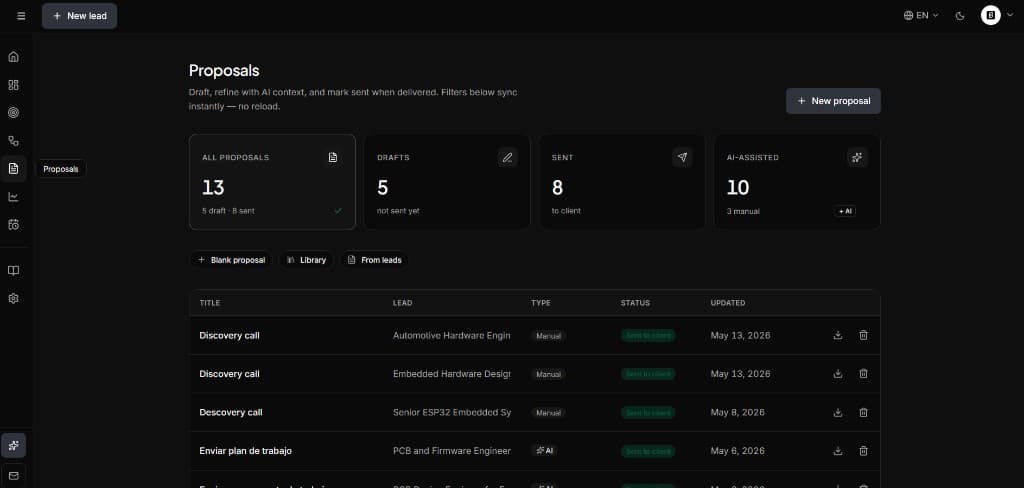
SoloPipeline drafts proposals from lead details you already captured—scope, budget, source—so AI starts from context instead of zero.
Before you hit send: quality checklist
Run this list on every proposal:
- [ ] First paragraph references something specific from their brief
- [ ] Deliverables are bulleted and testable ("3 email templates" not "email support")
- [ ] Out of scope is stated
- [ ] Timeline names dependencies
- [ ] Price matches the scope (no accidental underquoting)
- [ ] One clear next step
- [ ] Proof link matches their industry or problem
- [ ] Deal moved to Proposal sent in your CRM or tracker
After you send: follow-up is part of the proposal
A proposal without follow-up is incomplete. Most freelancers lose here—not in the draft.
Default sequence:
- Day 2: "Wanted to confirm you received this and see if any questions came up."
- Day 5: Share one relevant detail you did not include initially.
- Day 10: Ask directly about timeline and decision process.
Full templates in our follow-up guide.
Common proposal mistakes
Leading with your biography. Credentials matter after you show you understand their problem.
Burying the price. Clients will scroll to find it anyway. Hiding price feels evasive.
No scope boundaries. Undefined scope creates bad projects even when you win.
Rewriting from scratch every time. Use a freelance proposal CRM or content library for sections 3–6; personalize sections 1–2.
No tracking. If you cannot list proposals sent this month, you cannot improve win rate.
Tools that support the proposal workflow
You need three layers:
- Lead context — source, budget, notes, conversation history
- Draft + library — templates, AI assist, version tied to lead
- Pipeline stage — Proposal sent with follow-up dates
Spreadsheets handle layer one poorly. Generic docs handle layer two without linkage. A freelance proposal CRM like SoloPipeline connects all three.
Compare CRM options in our buyer's guide.
Summary
How to write freelance proposals that win:
- Mirror the client's goal in the opening
- Use the seven-part structure: situation → approach → deliverables → timeline → price → next step
- Present pricing with confidence and clear scope boundaries
- Customize the hook; reuse the methodology sections
- Use AI for speed, human judgment for credibility
- Track sends and follow up on schedule
Master the structure once. Improve the personalization every time. Let tooling handle the admin so you spend energy on the sentences that close deals.
Frequently asked questions
How do you evaluate a freelance proposal professionally?
Score it against the same signals clients use to reduce risk. Check that the opening references the client's specific situation instead of a generic pitch, that deliverables are bulleted and testable, and that an explicit out-of-scope line exists. Then verify the timeline names dependencies, the price is transparent (one number or a simple tier choice), and there is exactly one low-friction next step. A proposal that passes all seven sections of the structure above is professionally sound; one that leads with the freelancer's biography or hides the price is not.
What should a freelance proposal example look like?
A real freelance proposal example contains specifics, not placeholders: a named project, a concrete price, dated milestones, and a single clear call to action. It opens by mirroring the client's goal in their own language, lists deliverables with explicit boundaries, and closes with one ask such as booking a call or approving a milestone. See the two full examples in this article—one short Upwork-style proposal and one longer direct-client proposal—for exactly what that looks like in practice.
What's a good freelance proposal template?
The most reliable template is the seven-part skeleton in this guide: opening mirror, situation summary, recommended approach, deliverables and boundaries, timeline, investment, and next step. Keep sections 3–6 as reusable blocks in a proposal library, and rewrite sections 1–2 for every lead so the proposal never reads as copy-paste. The copy-ready version in this article works for Upwork, email, and referral proposals with minor tone adjustments.
How long should a freelance proposal be?
Upwork proposals should run 300–500 words, because clients skim twenty submissions in one sitting and reward relevance in the first two lines. Direct or referral proposals can be longer—roughly one to two pages— since there is room for more context and a linked case study. In every channel, a focused two-page proposal beats a ten-page deck nobody finishes; length should come from scope clarity, not padding.
What's the biggest mistake freelancers make in proposals?
Sending a generic template with the client's name swapped in. Clients reward proof that you read their situation, so a proposal that opens with your biography instead of their goal loses before pricing is even discussed. The second-biggest mistake is skipping follow-up: most deals are lost after the send, not in the draft, so track every proposal and follow up on day 2, day 5, and day 10.